have you thought that maybe the massive increase in pressure and the massive amount of turbulence you're relying on for thermal conductivity would have a heating effect also?


 Re: Why Doesn't a Fractal Heatsink exist?
have you thought that maybe the massive increase in pressure and the massive amount of turbulence you're relying on for thermal conductivity would have a heating effect also?

 Re: Why Doesn't a Fractal Heatsink exist?
Well hey now, traditional radiators function basically exactly the same as my radiator/heatsink,mines just got fractal tubes inside. But maybe it would be a better idea to have all the hots enter one side and exit the other, I'd just worry about one side of the radiator getting hotter then the other, i've noticed on the radiators we use now, the first inch or two of the internal radiator tube is pretty damn warm. I was hoping to defeat that with the opposing flows.Originally Posted by dr.walrus

lol probably, but you know i'm just dreaming, so as long as its still in my head or on a piece of paper there won't be a pump failure and if you don't dream you don't design, and if you don't design nothing gets invented or discovered. Einstein was wrong as some of the little things, but as a whole the guy was a f@#king genius.
pump failure pump failure pump failure pump failure
You sure?I see what you're getting at, but this would still increase the pressure throughout the system...
I'm pretty good at pneumatics and when you use a reduction gate 120psi can be reduced to 60psi or less depending on the I/D of the hose. Majorbud has a butterfly glass optimizer that needs to function at 60psi, while the rest of the buildings pneumatics needs to function at 120psi so they use a fancy reduction gate to reduce the pressure, I'd guess worst case scenario i could use a reduction gate as well.
Hell i've seen video cards and processors with a 4 figure price tag, 3 figures is pretty common on bleeding edge technology.This would have at least 3 zeros on the price tag, I'm not sure I'd want to take that risk!
thats why you could disassemble it down to the individual tubes and blow them out with a hi-pressure pneumatic hose or just run a garden hose through withever tube was affected. the thing would slide out as a whole and be able to get disassembled like a lego house.Yeah but at a few thousand dollars in cost, I'd be very unhappy if the response to 'it's blocked' was 'oh well'
There are only two gaskets, one on each end to seal the manifold against the tubes. the tubes themselves would be fitted together like a giant tetris shape. because after all... tetris is just a fractal geometry game.
The gaskets would just insulate each layer, making the whole design pointless!
so it ought to stay at room temperatures and withstand loads even better then a traditional radiator? Since its fractally based, like i said you can scale it up or down to what ever size you wanted or what ever amount of tubes you wanted, I think i just overshot the size in the traditional concept. If a few inches worth of copper is all you need, then you could do the math and come out with internal tubes that are 8" long that fit in a 2" heatsink assembly and come out with a copper tube that together would be several feet long in a extremely small package.
Bizarrely, this is the exact problem with the heatsink. If it does everyhing you say, it'll be far too good at transmitting heat.
Water would get even 1/10 of the way through the heatsink before normalising with the temperature of the heatsinks. The rest of the way through, it's not doing any cooling, it's just sat there at the same temperature. The only way to deal with this problem, and get the full potential out of this absolutely beautiful idea is with super high flow rates. And therefore silly pressures.
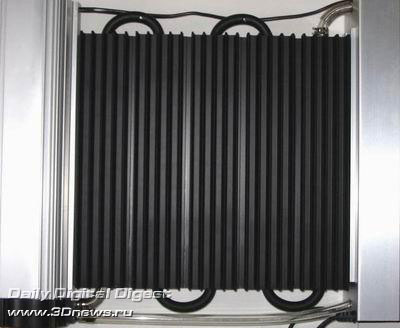
This assembly is the radiator. It'd have large fins sticking off all the sides like the radiator in the pictures above, It'd also sit OUTSIDE the computer chassis under a table, in your fridge, sitting in a bucket of ice or what ever you wanted to. You could even attach fans to it like a classic radiator.And what do you do with this enormous amount of heat you extract? You're going to need a BIGASS radiator and that would preferably have some auxillary cooling too. Else, you're just pulling all that heat out, and dumping it straight back into the system!
If you look at the 2nd diagram you'll notice that a smaller fractal radiator is put after the res and single pump.
and after some digging it seems zalman (the company you all love so much as you've all song there praises about radiator design before) has almost duplicated my radiator to a T outside the fact that they've kept with the traditional looping S design for the actual tube that travels through the radiator.
Instead of my series of nerd math semi interconnected/interleaving tubes that makes the most of surface area in as little of a package as possible.
I'm thinking now my fractal heatsink would actually be 1/3rd the size i originally thought i'd need to cool a system off.
Re: Why Doesn't a Fractal Heatsink exist?
accidental double post.
Re: Why Doesn't a Fractal Heatsink exist?
I think some of you don't exactly "know" what fractals are.
http://www.pbs.org/wgbh/nova/fractals/
PBS made a totally awesome show explaining fractal geometry based from the various sets mandelbrot created. it'll totally blow your f@#king mind if you watch that show in its entirety. Mandelbrot had worked for THE most important computer industries world wide, He devised the fractal set that allowed packets to be transmitted via long distances with out error. he also came up with the fractal set that allows video games to be more then just a bunch of 2d squares.
remember "rescue on fractulus" the video game? that was the first game to take advantage of mandelbrots sets he created in the mid 1990's
Soon after that Consoles like the SNES and computer graphics started to become three dimensional.. You can thank him for pretty much any video game you've played in the past 20 years.
You can also thank him for most of the programming languages made today, and binary in and of itself and the central processor inside your computer.
http://en.wikipedia.org/wiki/Arbitra...ion_arithmetic
also Take in case... Cell phones.
Remember awhile back cell phones had huge antennas sticking off of them?
then all of a sudden the phones lost the antennas and then shortly after that they could recieve not only radio transmissions. But wireless blu-tooth GPS and other freqencies all similtaniously?
That is thanks to the fractal based antenna.
(from wikipedia, link provided below)A different and also useful attribute of some fractal element antennas is their self-scaling aspect. In 1999, it was discovered[9] that self-similarity was one of the underlying requirements to make antennas "invariant" (same radiation properties) at a number or range of frequencies. Previously, under Rumsey's Principle, it was believed that antennas had to be defined by angles for this to be true; the 1999 analysis, based on Maxwell's equations, showed this to be a subset of the more general set of self-similar conditions. Hence fractal antennas offer a closed-form and unique insight into a key aspect of electromagnetic phenomena. To wit: the invariance property of Maxwell's equations: this property being in keeping with the fundamental nature of Maxwell’s derivation and mathematical treatment of electromagnetic phenomena, and is further demonstrated by its complete harmony and integration with Einstein’s special theory of relativity.
Heres one
Why is it that antenna despite being 1x1 inch squared, is 300x stronger then the traditional straight antennas and can receive multiple signals at once?
Because stretched end to end that antenna is well over 10' foot long in multiple shapes and patterns, fractal geometry just says that you can break it in half, make a right angle, multiply it again and you'll have double the size in half the space. you can do this over and over and over and over and you'll get smaller and smaller and longer and longer. you can also change angles of the break and create several self repeating patterns.
Heres a quote from wikipedia
http://en.wikipedia.org/wiki/Fractal_antennaA fractal antenna's response differs markedly from traditional antenna designs, in that it is capable of operating with good-to-excellent performance at many different frequencies simultaneously. Normally standard antennas have to be "cut" for the frequency for which they are to be used—and thus the standard antennas only work well at that frequency. This makes the fractal antenna an excellent design for wideband and multiband applications.
That PBS show can explain it a HELL of alot better then my arguably stupid a@# can though, they also cover fractal antennas in the show.
Well i had got to thinking, since fractals can give maximum efficiency of a given space and the current design of radiators have one single tube that makes a few lazy S curves through a radiator barely touching the cooling tube as a whole. ( dunno the math but i'd gamble to say its less then 50% of the tube attached to the actual physical radiator)
Why not multiply the amount of tubes 10 fold, break and angle the lines every so often so they interlace with each other, and have those tubes function as a heatsink in and of itself.... inside a radiator to gain maximum surface area with a heatsink.
This man single handedly change the face of the modern world and just about everyone has no idea who this man is.
So i basically figured that if he has had such a profound touch on electronics and how they operate and function... Why can't his mathmatics be applied to cooling electronics as well?
Damn... Wish i had AutoDesk CAD this would be a hell of a lot easier to explain if i could do it in the third dimension.
Re: Why Doesn't a Fractal Heatsink exist?
water is just about physically impossible to compress outside of ridiculous pressures and turbulence actually helps with thermal conductivity (that whole opposing flows deal) after some research and a calculator it seems that higher pressures actually wouldn't be created. Only a higher velocity through the radiator.
http://www.jupiterheating.com/ergoma...er-heater.htmlTurbulence is also created within the ERGOMAX tank to maintain an ideal environment for heat transfer.
Theres a water heater that uses turbulence to efficently transfer heat.
Heres a science page explaining why water has a higher thermal transfer when agitated.
http://www.arca53.dsl.pipex.com/index_files/ac5.htm
turbulent water flow, like turbulent airflow, also reduces resistance to heat transfer. And, like fin geometry, it can become an important criterion for coil selection. Waterside turbulence can be created by metal ribbons or helical wires inside the tubes. Called turbulators, these devices create eddies as the water flows across them.
Both methods of improving the heat-transfer coefficient (increased velocity and turbulence) create higher pressure drops, which can mean additional fan or pump power.
So it sort of seems, that no real additional pressures would be created, the angles inside would be beneficial at agitating the water for a higher co-efficiency rating and mandelbrot might of been onto something.
This kind of tickled because its exactly the premise behind my radiator
(from website above)Any additional increase in heat-transfer capacity must be achieved by physically increasing the available surface area; that is, by:
Adding rows
Adding fins
Increasing the physical size of the coil.
I basiclly increased the amount of rows by over 200, the tubes in and of themselves are also fins, so jesus knows how many fins i've added over a tradtional style radiator.
And i didn't increase the physical size of the radiator.
Re: Why Doesn't a Fractal Heatsink exist?
I'll give you that one
And it would do that very well - but at the expense of a few degrees. owever, doesn't the copper itself and its own thermal performance minimise hot spots?
One motor, many rotors?
That would certainly do it
Ability to disassemble is at the cost of thermal performance, and vice vesa. Jus' sayin'...
I suppose what I'm saying is, you're going to have some very long, narrow channels. So once the heat normalises between the liquid and the heatsink, you want it out as soon as possible. Once it's heated up, it will continue heating if it's not removed. So the very long channels are acting as a method to get the water extremely hot; and as such, to allow the heatsink to get extremely hot. And the only way to counter that is a very high flow rate.
Those things are great. I think moving all the stuff outside the computer is great for leak prevention. Limiting the tubes coming in and out is a great idea.
It'd be tiny, but the manifold system might be enormous!
What I'm really getting at is this; in answer to your original question, you're right, there's certainly possibilities to improve our current radiator/heatsink designs using fractal mathematics. However, I think you've overcomplicated the issue somewhat! A quad loop system for a single component is going to be problematic, however you look at it.
Re: Why Doesn't a Fractal Heatsink exist?
I sent this discussion to a few Physicists, waiting on a response!
They'll probably tell me im a idiot with a slim chance of "zomg your brillant"
Re: Why Doesn't a Fractal Heatsink exist?
Yay!
I'd guess so, maybe its time to watch science channel shows about copper and read some science articles to understand how copper works exactly?And it would do that very well - but at the expense of a few degrees. owever, doesn't the copper itself and its own thermal performance minimise hot spots?
I'd almost wonder if a cork screw style pump would be best for this instead of the fan blade style pumps. just a theory thoughOne motor, many rotors?
yay
That would certainly do it
i'm sure it would, but when i look at air cooled heatsinks. some of them heatpipes are just "touching" the radiator and not soldered at all. but yet they post the best temperatures.Ability to disassemble is at the cost of thermal performance, and vice vesa. Jus' sayin'...
I'd "Assume" that if i could actually sonic weld the pieces together, there wouldn't be much warping to the two sides that make up two panels that make a single "pipe" since not much heat is created from it. so that might let those hundred (or dozens depending on the scale) sammich' together rather tightly. and i'd kinda assume to that once you start shooting high velocity water jets through it, the panels would flex out and press against each other (thickness of the walls i'm thinking would be about 1/32nd of a inch thick.. or the size of a regualar radiator's fin)
sounds like over my head math, but i'm sure someone could calculate the physics involved and how long it would take water at such and such a temperature to return to room temps (supposed temp of the outer heatsink shell itself) in a given width and length of copper pipe.I suppose what I'm saying is, you're going to have some very long, narrow channels. So once the heat normalises between the liquid and the heatsink, you want it out as soon as possible. Once it's heated up, it will continue heating if it's not removed. So the very long channels are acting as a method to get the water extremely hot; and as such, to allow the heatsink to get extremely hot. And the only way to counter that is a very high flow rate.
now just take that copper pipe, use that math and make it fit in as small of a package as possible.
all in all i think you could even get away with the classic "single pipe" method that radiator use right now? Only... well "fractalize" it and make it touch as much of the radiator as physically possible.
lol i thought the same thingThose things are great. I think moving all the stuff outside the computer is great for leak prevention. Limiting the tubes coming in and out is a great idea.
probably, but man car intake manifolds can do a lot in a little space these days, i'm sure with revision the manifolds could get pretty slim.. hell just look the head for the Corsair H50 Vs the later revised Corsair H70.It'd be tiny, but the manifold system might be enormous!
Theres actually only two hoses running per device like a classic water cooling system that has independent loops (like one loop consisting of two hoses for the video card, and another for the proccessor) The four hoses in my design. But if you look at my buddies design its one single loop through the whole system so really you would only need the traditional One enter and one exit.What I'm really getting at is this; in answer to your original question, you're right, there's certainly possibilities to improve our current radiator/heatsink designs using fractal mathematics. However, I think you've overcomplicated the issue somewhat! A quad loop system for a single component is going to be problematic, however you look at it.
And FYI thanks for bouncing back responses to me! You never know how good or terrible something is unless you've got someone to hate on it for you so you think about it harder.
Patent Pending
Re: Why Doesn't a Fractal Heatsink exist?
...you can have pressure without compression?
Yes, turbulence totally aids thermal transfer. But it also causes heat in its own right. And at a certain scale, micro effects tend to overcome macro effects...
Re: Why Doesn't a Fractal Heatsink exist?
Sure! Who knows if I'm right!
 Posting Permissions


 Reply With Quote